


- Breast Augmentation Gallery
- Breast Augmentation with Lift
- Breast Lift Gallery
- Breast Reduction Gallery
- Breast Revision Gallery
- Earpinning (Otoplasty)
- Eyelid Lift (Blepharoplasty)
- Facelift Gallery
- Gynecomastia/ Male Breast
- Tummy Tuck Gallery
- Liposuction Gallery
- Mommy Makeover Gallery
- Nose Surgery (Rhinoplasty)

Tummy Tuck Surgery in Denver, Highlands Ranch, Littleton, CO
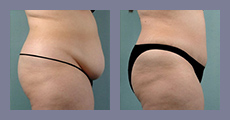
Board Certified Plastic Surgeon Dr. Paul Zwiebel can help you to achieve a more youthful abdominal profile and the fit appearance you seek with a Tummy Tuck. An Abdominoplasty or, ‘tummy tuck’ is a procedure designed to tighten the muscle of the abdomen, remove fat above the muscle and under the skin, and tighten and smooth excess skin of the abdomen.
If you have loose or sagging abdominal wall skin (often a result of multiple pregnancies or prior treatment), excess skin, or a stubborn bulge you can’t get rid of with exercise, you may be a candidate for abdominoplasty. At his plastic surgery center in Littleton, Colorado, board certified plastic surgeon Dr. Paul Zwiebel performs this procedure which is intended to give the patient a smoother, flatter abdomen.
An Abdominoplasty Addresses These Three Areas:
- the muscle of the abdomen
- the fat of the abdomen
- and excess skin of the abdomen
Each patient will have a varying degree of need for each area, and the tummy tuck procedure itself is modified per patient. The incision size required will fluctuate according to the patient’s situation, but usually extends across the lower abdomen above the pubic bone. The incision allows us to tighten the underlying muscles, remove fat, and excise excess skin. This creates a smooth, flat abdomen. For women considering future pregnancies, Dr. Zwiebel suggests postponing an abdominoplasty procedure since pregnancy may diminish results.
Unlike most practices, Dr. Zwiebel, provides abdominoplasty patients with anesthesia pumps when performing the procedure of tummy tuck, Denver specialist says. An anesthesia pump is a small device with a thin catheter that connects to the central nerve bundle in the abdomen. It drips local anesthetic into the treatment area for three to four days and numbs the area enough for patients to significantly reduce their dependence on narcotics (which can have side effects). Our patients are much more comfortable with this device and experience easier recovery.
We would like to emphasize that abdominoplasty is a surgical procedure and, as such, carries with it some risk. Dr. Zwiebel encourages all patients to learn as much about the process before undergoing abdominoplasty plastic surgery. Our patients should gather as much information as possible.
As a board certified plastic surgeon performing tummy tuck, Denver expert Dr. Zwiebel’s experience and training, combined with his focus on safety and excellence of result will help you to achieve the aesthetic goals you are seeking.
You are always invited to direct your questions and concerns about a tummy tuck to Dr.Zwiebel and his attentive staff. Dr. Zwiebel strives to develop trust and rapport with each of his patients.
Tummy Tuck Experience
Frequently Asked Questions about Tummy Tucks
Abdominoplasty is the technical word for a Tummy Tuck, an elective cosmetic surgery that improves the shape of the tummy (abdomen).
A tummy tuck or abdominoplasty can remove extra skin and extra fat from the tummy. The abdominoplasty/tummy tuck can also repair the muscles of the tummy, if they have been stretched by pregnancy or weight gain. Abdominoplasty is a name for many different procedures used to improve the appearance and shape of the tummy; the type of technique or combination of procedures is customized to best suit the needs of each individual.
You may be a good candidate if:
- You are in good general health;
- You have laxity of your tummy skin or muscles, a “poochy” abdomen, or are bothered by the appearance of your tummy;
- You can take the time and have the help to recover properly;
- You have realistic expectations:
- You understand what a tummy tuck can and cannot do.
- You understand that a tummy tuck is a real surgical procedure that has risks and potential complications.
Tummy Tuck/Abdominoplasty is very individualistic and the best way to learn if you are a good candidate is through a personalized consultation and examination.
In addition to wanting the best cosmetic outcome, your health and safety is paramount as you consider an elective cosmetic procedure. That’s why you should choose your surgeon carefully.
- Choose a Plastic Surgeon Certified by the American Board of Plastic Surgery
- A Board Certified Plastic Surgeon has gone through the most extensive approved training for these types of procedures and has passed rigorous testing demonstrating competence.
- Choose a Plastic Surgeon with experience
- You want someone who has extensive experience in performing many types of tummy tucks and has demonstrated excellent outcomes.
- Choose a Plastic Surgeon with a team of professionals who will work together to give you the care and support you want and need.
- During your consultation, make sure you feel good about the doctor and his staff:
- Do they listen and seem to care, or do you feel rushed?
- Is the doctor paying attention to your goals and your questions?
- During your consultation, make sure you feel good about the doctor and his staff:
The terms that you might hear most often are “Full Tummy Tuck.” “Partial-” or “Limited Tummy Tuck.” and “Mini-Tummy Tuck.”
Generally, a “Mini Tummy Tuck” is a procedure where only a “pinch” of skin and fat is removed from the lower part of the tummy. This is suitable for individuals with a little loose skin in the lowest part of the tummy, above the pubic area. This procedure is easily done with a local anesthetic (injections of numbing medicine) in less than an hour. Most normal non-strenuous activities can resume right away.
The “Partial-” or “Limited Tummy Tucks” are procedures for removing a roll of skin and fat from the lower tummy, below the belly button. These procedures might include some liposuction or repair of muscle in the lower abdomen.
“Full Tummy Tucks” are operations that involve the full length of the tummy, above and below the belly button (umbilicus). Full Tummy Tucks are needed when there excess skin or laxity in the upper part of the tummy or more extensive repair or reshaping is desired.
The best way to find out what kind of Abdominoplasty you need is to have a consultation with a Board Certified Plastic Surgeon with a lot of experience in body contouring procedures like tummy tuck.
Liposuction is often done as part of a tummy tuck procedure to give optimal contouring when there is extra fat in the tummy. Liposuction of the waist or hip rolls may be important to give the best results.
How do I know if I just need Liposuction, or if I need a Tummy Tuck?
These questions are very common!
Liposuction and Tummy Tuck or Abdominoplasty do different things: Liposuction is a procedure ideally suited for fat removal only; Tummy Tuck will also remove loose skin and can be used to tighten lax, stretched muscles, muscles that are split or separated (“diastasis”) by pregnancy or weight loss, or repair a hernia.
Generally speaking, if you have some extra fat around your tummy, but skin tone is good, liposuction may be the best option. If you have extra or loose skin, skin folds or a weakened muscle wall in your tummy, abdominoplasty or tummy tuck is likely the better procedure.
We often see situations where the muscle wall is weakened by pregnancy or weight gain. An area of weakness can sometimes allow some of the core fat (intra-abdominal fat) push through, creating a bump or bulge. This is quite common in the umbilicus: after pregnancy, many women notice their belly button has gotten quite big or bulges intermittently. This may be the result of a hernia.
We commonly repair hernias at the same time as the tummy tuck. We fix the hernia by replacing the fat back into the tummy and put in stitches that close the opening and reinforce the muscle over the area.
Pregnancy or weight gain stretch the abdominal wall (the muscles of the tummy that hold all the organs inside). Sometimes the muscles don’t recover from that stretch and remain weak or loose. This can leave a gap down the middle of the tummy, between the muscles on the left and right sides. If this gap is weak or large enough, the tummy stays too round or “poochy,” despite intense abdominal exercising.
The separation of the muscles is called a diastasis. This can be repaired with strong stitches during a tummy tuck procedure, resulting in a nice, flat tummy.
A drain is a small tube that is placed in an area during surgery to help prevent fluid (blood or serum) from accumulating in the wound. Fluid accumulations (“hematoma” or “seroma”) can delay healing or even increase the risk of infection. To prevent such an accumulation after abdominoplasty or tummy tuck, surgeons use drains for a few days after the procedure, until the skin starts to heal down to the underlying muscle layer of the tummy, and the risk of hematoma or serum has passed. The drain is usually stitched in place in or near the suture line and is removed in the office at a follow-up visit.
An alternative to using drains is to place additional internal dissolving stitches between the skin and the muscle so that the two layers are closely attached, leaving no room for fluid to accumulate. This procedure takes a bit more time during surgery, but is really worth it: not only does it eliminate the need for drains, but it helps for a better scar by reducing the pulling on the skin incision line.
Planning for a good recovery is every bit as important as a good operation! You get only one chance to recover well!
Recovery time depends upon the type of procedure: for example, a mini-tummy tuck will have a much shorter recovery than a full tummy tuck with muscle repair.
A mini-tummy tuck will typically require just a day or two of rest before returning to a normal daily schedule, but certain strenuous activities may be restricted for a couple weeks.
With a full tummy tuck, we generally expect about two weeks off work and before most normal activities can be resumed, and six weeks before resuming strenuous activities.
The vast majority of tummy tuck procedures are performed safely as out-patient procedures. Most tummy tuck patients do better recovering in the comfort of their own home. If you feel you need additional help at home we have a Plastic Surgery Registered Nurse who is able to stay with you as long as you wish. She is also available to assist you with transportation.
To provide you with safety and comfort, I have a nationally accredited surgical suite where my team and I have performed hundreds of tummy tuck procedures. The advantages of doing tummy tuck/abdominoplasty in my in-office surgical suite include:
- privacy
- safety
- our surgical suite has passed rigorous inspection and re-certification to provide you with a safe environment for your procedure;
- because we perform only elective cosmetic procedures in our surgical suite, our infection rate is much lower than at the hospital and we avoid the exposure to antibiotic-resistant infections that occur at hospitals
- comfort
- our surgical suite is designed to meet your special needs as a cosmetic abdominoplasty patient;
- the people who care for you at your consultation, pre-op- and post-op visits are the same people who care for you on your surgery day. Because my team works with me throughout your office visits and surgery, you will see familiar faces who already know you, on the morning of your tummy tuck, in the OR and in Recovery.
- efficiency
- Working together as a dedicated and cohesive unit, my staff and I are well drilled and familiar in working together as team during your procedure. We never rush through an operation, but working well together as a well rehearsed team means no time is wasted during surgery. Less anesthesia and surgery time means less risk of complications and a faster recovery.
When muscle repair is done during tummy tuck, the muscle can be very tender after surgery. That’s why we use a “pain pump” to dramatically reduce the pain after tummy tuck. A “pain pump” is an ingenious and simple device that drips local anesthetic into the area of surgery, numbing the area and reducing the amount of pain medicine patients need to take. We did a study in our practice and found that patients took half as many pain pills after tummy tuck when we use the pain pump. Besides having less pain and feeling better faster, taking fewer narcotics means less chance of side effects like drowsiness, constipation and nausea.
We commonly combine other procedures with tummy tuck, as it makes sense to combine the recovery time. There is also an economic benefit, because combining procedures is much less expensive than doing them separately.
Liposuction is very common with tummy tuck, improving body contours for symmetry and balance of proportions.
Many women request breast augmentation, breast lift, or breast reduction at the same time as abdominoplasty or tummy tuck. Because so many women develop drooping or laxity of both their breasts and tummy after pregnancy, this combination of procedures has become so popular and common that it called a “Mommy Makeover,” and is one of the most frequent procedures we do in my practice. The results are very gratifying!
A Tummy Tuck or Abdominoplasty is not a procedure for weight loss; it is an operation to improve contours, not remove pounds. The operation will definitely make someone look slimmer by removing extra skin and fat, or repairing a weakened muscle wall, but the tummy tuck isn’t about taking off the pounds. (The same is true for liposuction) Weight loss is best accomplished through healthy lifestyle changes: diet and exercise.
How much weight should I lose before my Tummy Tuck?
We want to time your Abdominoplasty so the benefits will last. If you are having a lot of weight fluctuation, it is best to wait until your weight is stable. If you have lost weight, it is best to schedule your Tummy Tuck when you are close to your target weight. Depending on the amount of weight you are trying to lose, I usually recommend getting within 10- to 15-pounds of your goal.
Insurance may pay for repair of a hernia, but not for a tummy tuck, which is considered a cosmetic procedure. In cases of a very large amount of skin excess that hangs over the pubic area causing skin breakdown or hygiene problems, sometimes insurance will pay for removal of the excess, but not a full tummy tuck. These instances would be considered medical conditions and you would need a referral from your primary care doctor.
There are a few factors to consider when planning a tummy tuck after weight loss:
• Give yourself enough time to be sure you are maintaining a stable weight, after your weight loss.
• Depending on your diet and activity during your weight loss, allow time for these to normalize, before undergoing the stress of surgery.
o Some unhealthy diets can create blood deficiencies: vitamins,minerals, electrolytes, anemia, protein deficiencies.
Such deficiencies can cause problems with anesthesia, drug reactions and interfere with healing.
Your doctor should check your blood tests before you undergo surgery.
• A period of regular exercise will have many benefits, before a tummy tuck:
o Improve cardiac and lung capacity before undergoing the physiological stresses of surgery and recovery;
o Improve circulation (blood flow), which will help with healing;
o Improve muscle tone, especially strengthening the abdominal muscles to optimize the effects of surgery, especially if some surgical repair of the abdominal wall is planned.
• Skin shrinkage is happening as you lose the weight: waiting weeks or months after a big weight loss will not result in much difference in the amount of skin that tightens on it’s own. It is unlikely you will see further shrinkage of the loose deflated skin.
o
The amount of shrinkage is a function of your tissues elasticity, an inherent quality of your skin, which is affected by:
weight fluctuations
hormones
age
genetics
smoking and other toxic exposures
general health
nutrition
sun exposure
• If you have been losing the weight gradually through sustainable lifestyle changes, including good nutrition with a healthy diet and exercise program, you need not wait to schedule your tummy tuck.
Otherwise, you may want to give yourself a couple months to stabilize.
Event Calendar

Ask Amy- Patient Coordinator
Your Safety